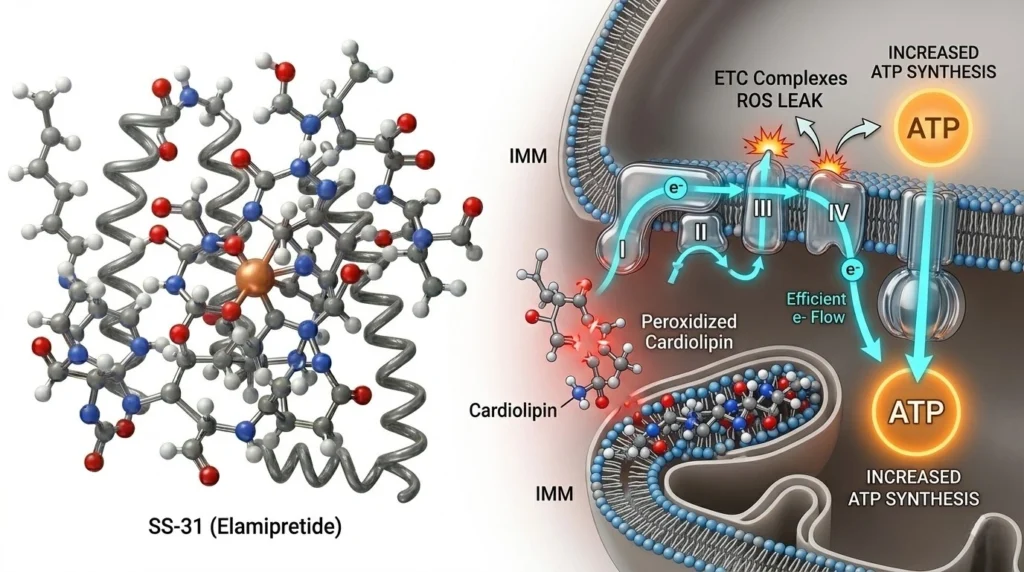
In the vanguard of mitochondrial medicine, SS-31 (Elamipretide) stands as a paradigm-shifting tetrapeptide. Unlike systemic antioxidants that offer broad-spectrum scavenging—often interfering with necessary cellular signaling—SS-31 operates with surgical precision. It targets the very epicenter of cellular energy production: the Inner Mitochondrial Membrane (IMM).
The Core Mechanism: The Cardiolipin-Cytochrome c Complex
The biological efficacy of SS-31 stems from its unique affinity for Cardiolipin (CL), a signature tetra-acyled phospholipid found exclusively in the IMM. As detailed in academic research, cardiolipin is the structural “architect” of mitochondrial cristae, anchoring the proteins involved in the Electron Transport Chain (ETC).
Under conditions of aging or metabolic stress, cardiolipin undergoes peroxidation, causing the cristae to collapse and Cytochrome c to detach. SS-31 selectively intercalates with cardiolipin molecules, forming a high-affinity protective complex. This interaction:
- Inhibits the peroxidase activity of the Cytochrome c-cardiolipin complex.
- Preserves the negative curvature of the IMM, maintaining efficient cristae morphology.
- Prevents the mobilization of pro-apoptotic factors into the cytosol.
Research Opportunity: For researchers looking to utilize this molecule in mitochondrial models, you can find high-purity SS-31 here.
Advanced Bioenergetic Optimization
1. Restoration of the Electron Transport Chain (ETC)
By stabilizing the cardiolipin environment, SS-31 ensures that Complex I, III, and IV (the supercomplexes) remain optimally spaced. This facilitates a more efficient flow of electrons, significantly reducing the “electron leak” that typically leads to superoxide formation and subsequent oxidative damage.
2. Enhancing ATP Phosphorylation Efficiency
Mitochondrial dysfunction is often characterized by a drop in the ATP/ADP ratio. SS-31 has been shown to restore ATP production in models of ischemia and cellular aging. By improving the coupling between oxygen consumption and ATP synthesis, cells can maintain higher energy states even under metabolic provocation.
3. Mitigation of mPTP-Induced Apoptosis
The Mitochondrial Permeability Transition Pore (mPTP) is a critical regulator of cell death. SS-31 helps maintain a stable mitochondrial membrane potential ($\Delta\Psi m$), raising the threshold for mPTP activation and protecting cells from premature necrosis or apoptosis.
Technical Specifications & Pharmacokinetics
To ensure high-fidelity research outcomes, the molecular integrity of SS-31 is paramount.
- Sequence: $D-Arg-Dmt-Lys-Phe-NH_2$ (The Dmt modification is essential for its antioxidant properties).
- Molecular Weight: 639.8 g/mol
- Bioavailability: Highly cell-permeable; concentrates in the mitochondria independent of membrane potential.
- Purity: ≥ 99% via HPLC/MS (Verify our latest batch in the [Quality Control] section).
Peer-Reviewed Scientific References
To further your research, please refer to these high-authority studies:
- PubMed (Official Index): Mitochondrial targeted peptide SS-31 and cristae restoration
- PMC (Full Text Archive): Comprehensive review of SS-31 in aging and disease models
- Nature – Scientific Reports: SS-31 prevents mitochondrial dysfunction and oxidative stress
- American Journal of Physiology: SS-31 targeting cardiolipin to improve cardiac bioenergetics
- ScienceDirect: Pharmacology and clinical potential of Elamipretide (SS-31)
Conclusion: Why SS-31 is the Gold Standard
SS-31 represents a transition from “symptom management” to “structural restoration.” By addressing the biophysical state of the mitochondrial membrane, it offers a robust tool for investigating the roots of metabolic decline.
Next Steps:
- Secure your research supply: [Purchase Research-Grade SS-31].