In the realm of regenerative peptide research, two molecules stand above all others for their restorative potential: BPC-157 and TB-500. While each peptide is potent individually, their combined “synergy” has become the gold standard for researchers investigating rapid tissue, tendon, and ligament repair.
Understanding the distinct yet complementary pathways of these two peptides is crucial for optimizing metabolic recovery studies.
Mechanism 1: BPC-157 — The Master of Angiogenesis
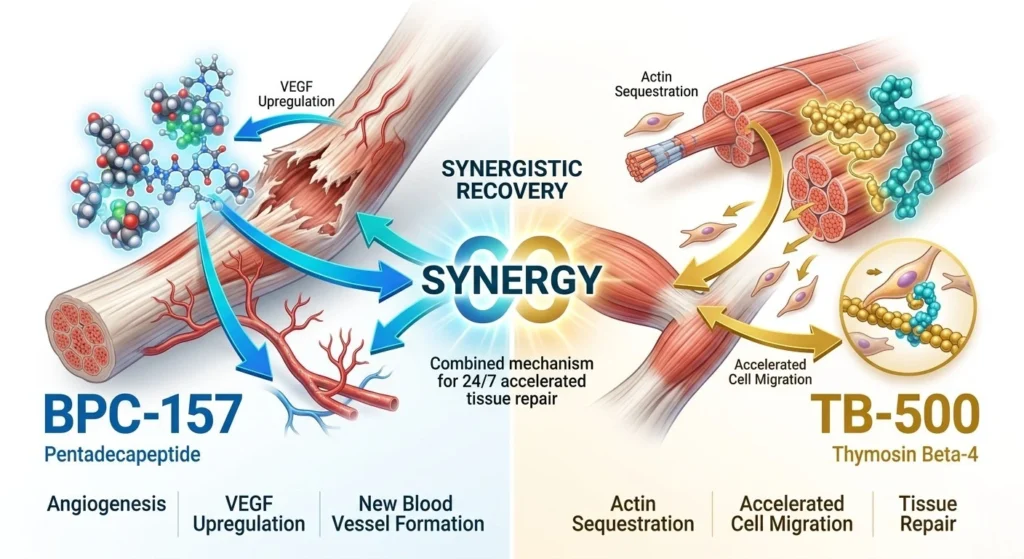
BPC-157 (Body Protection Compound 157) is a pentadecapeptide that mimics a protective protein found in human gastric juice. Its primary role in healing is the modulation of the VEGF (Vascular Endothelial Growth Factor) pathway.
BPC-157 accelerates the formation of new blood vessels—a process called angiogenesis. By increasing blood flow to localized injury sites (especially “white zones” like tendons and ligaments which have naturally poor blood supply), it provides the essential nutrients required for cellular reconstruction.
Mechanism 2: TB-500 — The Architect of Cell Migration
TB-500 is a synthetic version of Thymosin Beta-4, a naturally occurring regenerative protein. Its primary mechanism involves Actin Sequestration.
By upregulating actin—a protein vital for cell structure and movement—TB-500 allows repair cells (like fibroblasts and myoblasts) to migrate more efficiently to the site of damage. If BPC-157 builds the “roads” (blood vessels), TB-500 ensures the “workers” (cells) arrive on time and are ready to build.
Research Opportunity: For investigators focusing on complex tissue trauma, you can find our specialized BPC 157 + TB 500 Blends here.
The Synergistic Effect: Why Combine Them?
When co-administered, BPC-157 and TB-500 create a multi-phasic repair environment:
- Phase 1 (BPC-157): Rapid upregulation of growth factor receptors and stabilization of the site.
- Phase 2 (TB-500): Enhanced recruitment of progenitor cells and acceleration of collagen deposition.
- Phase 3 (Combined): Synergistic reduction of inflammatory cytokines (like IL-6 and TNF-alpha), preventing excessive scar tissue formation.
Technical Specifications
- BPC-157 Sequence: Gly-Pro-Pro-Leu-Ser-Lys-Pro-D-Pro-Asp-Asp-Asn-Ile-Gly-Val-Gly-Glu-Pro-Pro-Leu-Ser-Lys-Pro-D-Pro-Asp-Asp-Asn-Ile-Gly-Val-Gly-Glu-Pro-Pro-Leu-Ser-Lys-Pro-D-Pro-Asp-Asp-Asn-Ile-Gly-Val-Gly-Glu
- TB-500 (Thymosin Beta-4) Sequence: Ac-Ser-Asp-Lys-Pro-Asp-Met-Ala-Glu-Ile-Glu-Lys-Phe-Asp-Lys-Ser-Lys-Leu-Lys-Lys-Thr-Glu-Thr-Gln-Glu-Lys-Asn-Pro-Leu-Pro-Ser-Lys-Glu-Thr-Ile-Glu-Gln-Glu-Lys-Gln-Ala-Gly-Glu-Ser
- Purity: ≥ 99% via HPLC/MS (View our [Quality Control] reports).
Peer-Reviewed Scientific References (Authority Links)
- PubMed (Journal of Applied Physiology): BPC-157’s effect on tendon-to-bone healing
- PMC (NCBI Full Archive): Thymosin Beta-4 in systemic inflammation and repair
- Nature – Scientific Reports: Angiogenic potential of BPC-157 in vascular injury
- ScienceDirect: Actin-binding proteins and cell migration in tissue engineering
- Journal of Biological Chemistry: The role of VEGF in localized peptide-driven repair