
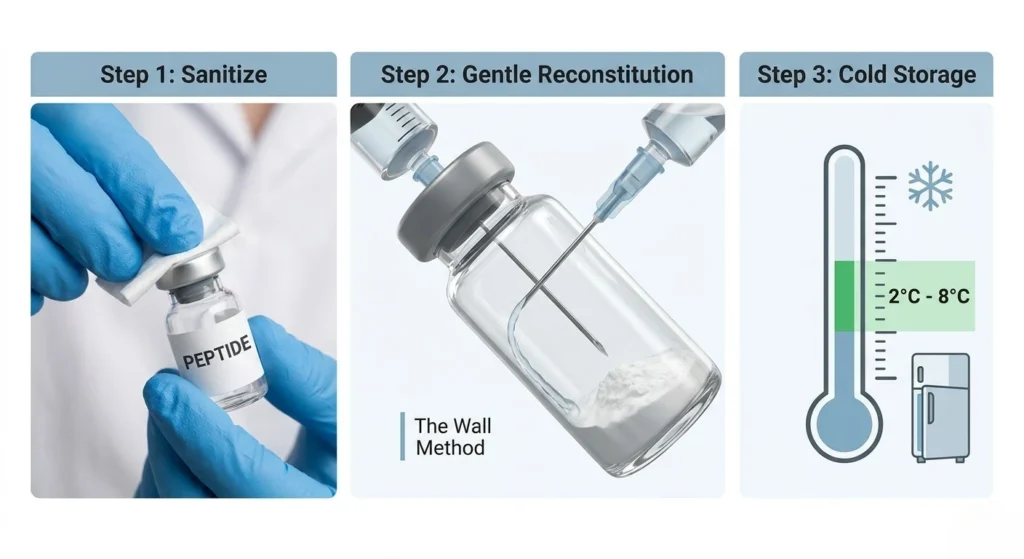
The integrity of a laboratory study depends not only on the purity of the lyophilized peptide but also on the precision of its reconstitution and storage. Improper handling can lead to peptide denaturation, aggregation, or loss of biological activity. This guide provides a standardized protocol for researchers to ensure maximum stability and potency.
1. Selecting the Right Diluent
The first step in reconstitution is choosing the correct solvent. Most research-grade peptides are lyophilized as acetate salts and are readily soluble in bacteriostatic water.
- Bacteriostatic Water (0.9% Benzyl Alcohol): The gold standard for multi-dose research. The benzyl alcohol acts as a preservative, inhibiting bacterial growth for up to 28 days post-reconstitution.
- Sterile Water: Suitable for single-use applications. However, it lacks antimicrobial agents, increasing the risk of contamination in long-term studies.
- Acetic Acid (0.6% – 1.0%): Required for hydrophobic peptides (those that don’t dissolve in water). A few drops can help clarify a cloudy solution.
2. The Reconstitution Process (Step-by-Step)
Precision and gentleness are the keys to maintaining the peptide’s secondary structure.
- Temperature Equilibrium: Allow the lyophilized vial to reach room temperature before opening. This prevents atmospheric moisture from condensing inside the vial.
- Sanitization: Swab the rubber stopper of both the peptide vial and the diluent with 70% isopropyl alcohol.
- Pressure Equalization: Gently insert a needle into the peptide vial to release any vacuum pressure before adding the liquid.
- The “Wall” Method: Aim the diluent at the glass wall of the vial rather than directly onto the lyophilized powder. This prevents aggressive foaming.
- Gentle Swirling: NEVER SHAKE the vial. Shaking causes mechanical stress that can denature the peptide bonds. Instead, gently swirl the vial until the solution is clear and colorless.
3. Concentration Calculation Formula
To ensure accurate dosing in your research, use the following simple formula:
Concentration (mg/mL) = Total Peptide (mg) / Volume of Diluent (mL)
Example: If you add 2 mL of bacteriostatic water to a 5 mg vial of BPC-157:
- 5 mg / 2 mL = 2.5 mg/mL
- Therefore, every 0.1 mL (10 units on a standard syringe) contains 0.25 mg of the peptide.
4. Strategic Storage Protocols
Peptide stability is highly temperature-dependent. Follow these storage tiers:
| Form | Temperature | Duration |
| Lyophilized (Dry) | 2°C to 8°C | 12 – 24 Months |
| Lyophilized (Dry) | -20°C to -80°C | Up to 60 Months |
| Reconstituted (Liquid) | 2°C to 8°C | 2 – 4 Weeks (Best use within 14 days) |
| Reconstituted (Liquid) | Frozen | NOT RECOMMENDED (Freeze-thaw cycles denature peptides) |
Key Storage Tips:
- Light Protection: Peptides are photosensitive. Store vials in their original boxes or wrapped in foil to prevent UV degradation.
- Vibration Control: Store vials in a stable part of the refrigerator, away from the door where frequent movement occurs.
Research Opportunity: High-quality research requires high-quality supplies. Explore our Laboratory Supplies for certified Bacteriostatic Water and Analytical Reagents.
Conclusion
Successful peptide research begins with meticulous preparation. By following these standardized reconstitution and storage protocols, investigators can eliminate variables related to peptide degradation and focus on the biological outcomes of their studies.
NOTE: These products are intended for laboratory research use only. This peptide is not intended for personal use. Please review and adhere to our Terms and Conditions before ordering.